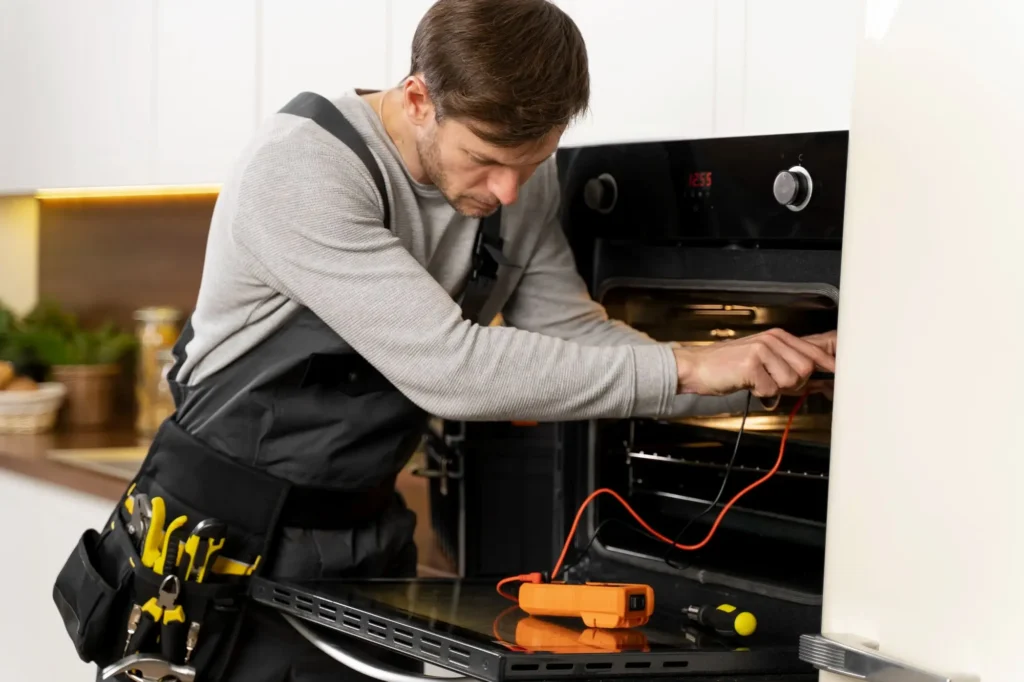
Few kitchen problems are as frustrating as turning on your oven, waiting for it to preheat… and realizing it’s not heating at all — or barely warming up. Whether you’re dealing with a gas or electric model, an oven that’s not heating properly can derail meals, waste time, and signal a deeper issue.
In this guide, we’ll break down why your oven is not heating, what you can safely check yourself, and when it’s time to call a professional. We’ll also cover common long-tail scenarios like oven not heating but stove works and oven not reaching temperature.
An oven not heating is usually caused by a failed heating element, faulty igniter, temperature sensor issues, control board problems, or power/gas supply interruptions.
The exact cause depends on whether the oven is electric or gas and whether it heats partially or not at all.
If you have an electric oven, these are the most frequent reasons it won’t heat.
This is the #1 cause of an electric oven not heating.
Signs:
Oven turns on, but no heat
Visible blistering or breaks in the element
Oven light and controls work, but temperature stays low
What happens:
Electric ovens rely on one or more heating elements. When an element fails, the oven simply can’t generate enough heat.
Long-tail keywords covered:
electric oven not heating
oven heating element not working
Sometimes the oven heats, but never gets hot enough.
Possible causes:
Weak heating element
Faulty temperature sensor
Calibration issues
Symptoms:
Food takes much longer to cook
Oven says it’s preheated, but food is undercooked
The temperature sensor tells the oven when to heat and when to stop.
If the sensor is faulty:
Oven may shut off too early
Oven may never fully heat
Temperature fluctuates wildly
Common search intent:
oven not heating evenly
oven temperature inaccurate
Modern electric ovens rely on electronic control boards.
Signs of control issues:
Oven won’t start heating at all
Error codes on the display
Oven randomly turns off
This is not a DIY fix and usually requires professional testing.
Gas ovens heat differently, and their failures have distinct patterns.
If your gas oven is not heating, the igniter is often the culprit.
Symptoms:
Oven won’t heat, but burners work
Igniter glows weakly or not at all
Long delays before ignition
Important:
A weak igniter may glow but still fail to open the gas valve.
Long-tail keywords covered:
gas oven not heating
oven igniter replacement
This is one of the most searched scenarios.
Why it happens:
Surface burners and oven use separate ignition systems
Stove burners working does NOT mean the oven igniter is good
If the stovetop works but the oven doesn’t heat, the igniter or oven gas valve is usually at fault.
Less common, but possible.
Signs:
No gas smell at all
Igniter works, but no flame
Oven shuts off shortly after starting
Gas-related issues should always be handled by a professional for safety reasons.
This gray-area problem confuses many homeowners.
Weak heating element (electric)
Weak igniter (gas)
Faulty temperature sensor
Control board miscommunication
Why diagnosis matters:
Replacing parts based on symptoms alone often leads to wasted money.
Before calling for service, you can safely check a few things.
✔ Confirm the oven is not in “Demo” or “Control Lock” mode
✔ Check the circuit breaker (for electric ovens)
✔ Make sure the oven is set to Bake (not Timer or Delay Start)
✔ Look for visible damage on heating elements
❌ Do not disassemble gas components
❌ Do not test live voltage without training
❌ Do not force ignition repeatedly on a gas oven
Certain symptoms mean you should stop using the oven immediately.
You smell gas
The igniter clicks continuously without ignition
The oven overheats unexpectedly
The oven shuts off mid-cycle repeatedly
Safety issues should always be addressed by a trained technician.
Many people ask whether it’s worth repairing an oven that won’t heat.
Oven is under 10 years old
Issue is isolated (element, igniter, sensor)
Appliance is otherwise in good condition
Multiple major components failed
Repair cost is close to replacement cost
Oven has ongoing electrical or gas issues
A proper diagnosis helps you make the right call.
Professional technicians don’t guess — they test.
Heating performance tests
Igniter current draw testing (gas)
Sensor resistance checks
Control board signal verification
Safety inspection
This prevents unnecessary part replacements.